Quilt Backing Calculator (Lengthwise or Crosswise Seams)
On this page
Most quilts are wider than a bolt of quilting cotton, so the backing has to be sewn from two or more widths of fabric. Which way you run the seams changes how much fabric you buy. The calculator works out both layouts and picks the one that uses less.
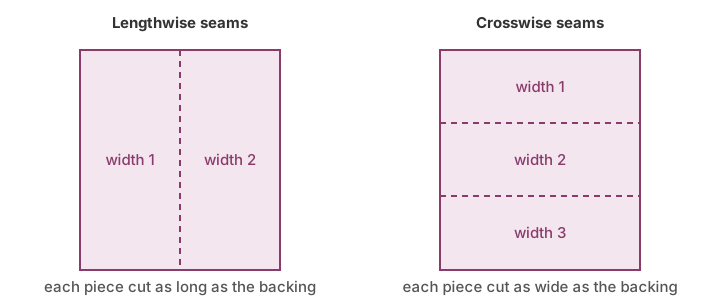
How the calculator works
- Backing size. Add the extra to every side: backing width = quilt width + 2 × extra, and backing length = quilt length + 2 × extra.
- Widths needed. Each seam uses up 1 in (two ½ in seam allowances). For lengthwise seams, the number of widths is the smallest whole number n where n × usable width − (n − 1) × 1 in reaches the backing width.
- Yardage. Each width is cut as long as the backing, so yards = n × backing length ÷ 36.
- Crosswise seams. Do the same with width and length swapped. The calculator shows both and picks the smaller.
Worked example: a 60 × 80 in quilt
- Backing: 60 + 8 = 68 in wide and 80 + 8 = 88 in long.
- Lengthwise seams: 2 widths give 2 × 42 − 1 = 83 in, which covers 68 in. Cut 2 pieces 88 in long: 2 × 88 ÷ 36 = 4.89 yd.
- Crosswise seams: covering 88 in takes 3 widths (3 × 42 − 2 = 124 in). Cut 3 pieces 68 in long: 3 × 68 ÷ 36 = 5.67 yd.
- Lengthwise seams save about three quarters of a yard, so buy 4.89 yd, or 5 yd if your shop cuts in 1/8-yard steps.
Quick check for common sizes
All rows use 4 in extra per side and 42 in usable width.
| Quilt top | Backing needed | Lengthwise seams | Crosswise seams | Buy |
|---|---|---|---|---|
| 40 × 50 in | 48 × 58 in | 2 widths, 3.22 yd | 2 widths, 2.67 yd | 2.67 yd |
| 60 × 80 in | 68 × 88 in | 2 widths, 4.89 yd | 3 widths, 5.67 yd | 4.89 yd |
| 84 × 92 in | 92 × 100 in | 3 widths, 8.33 yd | 3 widths, 7.67 yd | 7.67 yd |
| 100 × 92 in | 108 × 100 in | 3 widths, 8.33 yd | 3 widths, 9.00 yd | 8.33 yd |
The math for each row follows steps 1 to 4 above. When both layouts need the same number of widths, the cheaper one is the layout whose pieces are cut along the shorter side.
Tips before you cut
- Measure the finished top, not the pattern size. Tops often grow or shrink a little while piecing.
- Pre-washed fabric shrinks. If you pre-wash, measure the usable width after washing.
- Trim the selvages before sewing the backing seam. The usable width you enter should be the width after trimming.